

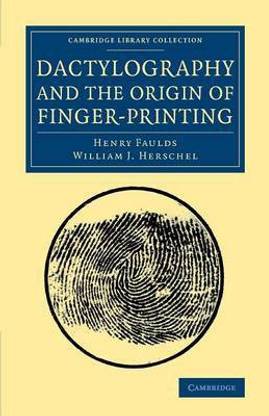
Dactylography and The Origin of Finger-Printing (English, Paperback, Faulds Henry)
Share
Dactylography and The Origin of Finger-Printing (English, Paperback, Faulds Henry)
Be the first to Review this product
₹4,211
₹4,246
Available offers

T&C
T&C
T&C
T&C
Delivery
Check
Enter pincode
Delivery by7 Feb, Saturday
?
View Details
Highlights
- Language: English
- Binding: Paperback
- Publisher: Cambridge University Press
- Genre: History
- ISBN: 9781108081252, 9781108081252
- Pages: 186
Seller

Description
The Scottish doctor Henry Faulds (1843-1930) and the English judge Sir William James Herschel (1833-1917) both recognised the potential of fingerprints as a means of identification. While working in Japan, Faulds had developed his methods after noticing impressions on ancient pottery. Herschel, during his service as a magistrate in India, had introduced a system of using fingerprints as a way of preventing fraud. In the course of a lengthy controversy, Faulds sought to be acknowledged for the significance of his discoveries. Although there is no doubt that Faulds was first to publish on the subject, it was Herschel's work, begun in the 1850s, which was later developed by Galton and Henry as the tool of forensic science we know today. Reissued here together, these two works, first published in 1912 and 1916 respectively, are Faulds' overview of the subject and Herschel's account of his work in India.
Read More
Specifications
Dimensions
| Width |
|
| Height |
|
| Length |
|
| Weight |
|
Series & Set Details
| Series Name |
|
Book Details
| Title |
|
| Imprint |
|
| Product Form |
|
| Publisher |
|
| Genre |
|
| ISBN13 |
|
| Book Category |
|
| BISAC Subject Heading |
|
| Book Subcategory |
|
| ISBN10 |
|
| Language |
|
Be the first to ask about this product
Safe and Secure Payments.Easy returns.100% Authentic products.




Back to top