

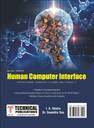
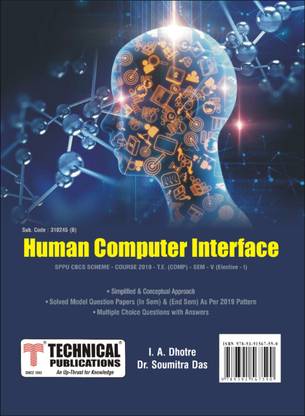
Human Computer Interface for SPPU 19 Course (TE - SEM V - COMP. - 310245(B) - Elective - I) (Paperback, I. A. Dhotre, Soumitra Das)
Share
Human Computer Interface for SPPU 19 Course (TE - SEM V - COMP. - 310245(B) - Elective - I) (Paperback, I. A. Dhotre, Soumitra Das)
Be the first to Review this product
₹230
Available offers

T&C
T&C
T&C
T&C
Delivery
Check
Enter pincode
Delivery by21 Dec, Sunday
?
View Details
Highlights
- Binding: Paperback
- Publisher: Technical Publications
- ISBN: 9789391567590
- Edition: THIRD, 2023
- Pages: 156
Services
- Cash on Delivery available?
Seller

Description
Unit I Introduction and Foundation of HCI Foundation : Human Memory. Thinking : Reasoning and Problem Solving, Emotion, Individual Difference, Psychology and design of Interactive systems, The Computer-Text Entry Device, Positioning, Pointing, Display devices, Devices for virtual reality and 3D Interaction, The Interactions-Models of Interaction, Frameworks and HCI, Ergonomics, Interaction styles, Ergonomics, Elements of WIMP Interface, Interactivity, Measurable Human Factors, The context of Interaction. Importance of User Interface : Defining user Interface, Brief History of Human-Computer Interface, Good and Poor Design-Importance of good design. (Chapter - 1) Unit II Human Perspective in Interaction Design Process Know your user/client : Understanding how people interact with computers, Important human characteristics in Design, Human considerations in design of Business systems, Human Interaction speeds, Performance versus Preference, Methods of gaining an understanding of users, Miller’s Law. Design Guidelines : Navigating the interface, Organizing the display, Getting user’s attention, Facilitating data entry. Principles : Determine user’s skill level, Identify the tasks, Choose an interaction style, Natural Language, Eight Golden rules of Interface design, Prevent errors, Ensuring Human control while increasing automation. Theories : Design-by-level, Stages of action, Consistency, Contextual Theories, Dynamic theories. (Chapter - 2) Unit III Interaction Styles and HCI in Software Process Design, Process of Interaction Design. Interaction styles : Command line, Menu Selection, Form fill-in, Direct Manipulation. Graphical User Interface : Popularity of Graphics, Concept of direct manipulation, Advantages, Disadvantages and characteristics of Graphical user interface. Web User Interface : Popularity and Characteristics, Merging of Graphical business systems and the Web - Characteristics of Intranet versus Internet, Web page versus application design, Principles for user interface design, Software life cycle, Usability Engineering, Iterative design and prototyping, Design Rationale. (Chapter - 3) Unit IV Usability Evaluation and Universal Design User interface design process : Designing for People : Seven commandments, Usability Assessment in the Design process, Common Usability problems, Practical and Objective measures of Usability, Formative and Summative evaluation, Usability specifications for evaluation, Analytic methods, Model based analysis, GOMS model, Empirical methods, Field studies, Usability testing in Laboratory, Controlled experiments, Heuristic Evaluation, Cognitive Walkthrough. Evaluation framework : Paradigms and techniques, DECIDE : a framework to guide evaluation, Universal design principles, Multi-modal interaction, Designing for diversity. (Chapter - 4) Unit V HCI Paradigms Paradigms for Interaction : Time sharing, Video display units, Programming toolkits, Personal computing, The metaphor, Direct manipulation, Hypertext, Computer-supported cooperative work, Agent based interfaces. Ubiquitous Computing : Sensor-based and context-aware interaction, Data Integrity versus Data immunity, Handling missing data, Data entry and fudge ability, Auditing versus Editing, Retrieval in Physical World, Retrieval in Digital world, Constrained Natural Language output, Five stage search framework, Dynamic queries and faceted search, The social aspects of search. Pattern Recognition : Introduction, Examples, Role of Machine Learning, Pattern Recognition Process, Pattern Recognition in HCI. (Chapter - 5) Unit VI HCI for Mobile and Handheld devices Designing for Mobile and other devices : Anatomy of a Mobile app, Mobile form factors, Handheld format apps, Tablet format apps, Mini-tablet format apps, Mobile Navigation, Content, and control idioms- browse controls, Navigation and toolbars, Drawers, Tap-to-reveal and direct manipulation, Searching, Sorting and Filtering, Welcome and help screens, Multi-touch gestures, Inter-app integration, Android Accessibility Guidelines. Other devices : Designing for kiosks, Designing for 10 - foot interfaces, Designing for automotive interfaces, Designing for audible interfaces. (Chapter - 6)
Read More
Specifications
Book Details
| Publication Year |
|
| Table of Contents |
|
University Books Details
| Stream |
|
| Degree/Diploma |
|
Additional Features
| Age Group |
|
Be the first to ask about this product
Safe and Secure Payments.Easy returns.100% Authentic products.




Back to top